Do you know what nosocomephobia is? I didn't either. Nor tomophobia, I just threw that one in, in case it comes up in another quiz. Pharmacophobia is a little easier to guess....
Nosocomephobia is the name of the phobia relating to the fear of hospitals. Tomophobia is a fear of surgery or surgical operations. Pharmacophobia is a fear of medicine.
Ross was our Quizmaster, and ran the room of 5 teams with precision and authority, especially when it came to the round on Science and Technology.
The Fightin' Irish
There were five teams: the Shamrocks; Danny Boy; The Lovely Ladies; The Fightin' Irish; and
the Singing Banshees. There were ten rounds, ten questions in each round, and we were underway after fortifying ourselves with delightful aperos made by Orla - smoked salmon, potato cakes, stuffed mushrooms.
Team Danny Boy
The Singing Banshees
Orla served dinner - Irish stew and Irish vegetables - halfway through the quiz, greatly appreciated by everyone. It gave us a chance to complete the picture quiz - pictures of various Pats/Patricks/Patrices (you get the idea). This included Pat Benatar (I thought this was Sheena Easton),
Patrick Buchanan, Patrick Dempsey, Neil Patrick Harris, and if we didn't know someone we put
down Patraig O'Shaughnessy - there must someone called that.
The Shamrocks Team
The Lovely Ladies
We had a great evening - the quiz was fun - and not quite so full of trivia as Orla had made out -
but we all learned something! Congratulations to everyone who took part - and our thanks to Orla
and Ross for a smashing evening. And to everyone who made this fundraiser a huge success.
Margaret Atwood on What ‘The Handmaid’s Tale’ Means in the Age of Trump
Credit
Eleni Kalorkoti
In
the spring of 1984 I began to write a novel that was not initially
called “The Handmaid’s Tale.” I wrote in longhand, mostly on yellow
legal notepads, then transcribed my almost illegible scrawlings using a
huge German-keyboard manual typewriter I’d rented.
The
keyboard was German because I was living in West Berlin, which was
still encircled by the Berlin Wall: The Soviet empire was still strongly
in place, and was not to crumble for another five years. Every Sunday
the East German Air Force made sonic booms to remind us of how close
they were. During my visits to several countries behind the Iron Curtain
— Czechoslovakia, East Germany — I experienced the wariness, the
feeling of being spied on, the silences, the changes of subject, the
oblique ways in which people might convey information, and these had an
influence on what I was writing. So did the repurposed buildings. “This
used to belong to . . . but then they disappeared.” I heard such stories
many times.
Having
been born in 1939 and come to consciousness during World War II, I knew
that established orders could vanish overnight. Change could also be as
fast as lightning. “It can’t happen here” could not be depended on:
Anything could happen anywhere, given the circumstances.
By
1984, I’d been avoiding my novel for a year or two. It seemed to me a
risky venture. I’d read extensively in science fiction, speculative
fiction, utopias and dystopias ever since my high school years in the
1950s, but I’d never written such a book. Was I up to it? The form was
strewn with pitfalls, among them a tendency to sermonize, a veering into
allegory and a lack of plausibility. If I was to create an imaginary
garden I wanted the toads in it to be real. One of my rules was that I
would not put any events into the book that had not already happened in
what James Joyce called the “nightmare” of history, nor any technology
not already available. No imaginary gizmos, no imaginary laws, no
imaginary atrocities. God is in the details, they say. So is the Devil.
Back
in 1984, the main premise seemed — even to me — fairly outrageous.
Would I be able to persuade readers that the United States had suffered a
coup that had transformed an erstwhile liberal democracy into a
literal-minded theocratic dictatorship? In the book, the Constitution
and Congress are no longer: The Republic of Gilead is built on a
foundation of the 17th-century Puritan roots that have always lain
beneath the modern-day America we thought we knew.
Photo
The
immediate location of the book is Cambridge, Mass., home of Harvard
University, now a leading liberal educational institution but once a
Puritan theological seminary. The Secret Service of Gilead is located in
the Widener Library, where I had spent many hours in the stacks,
researching my New England ancestors as well as the Salem witchcraft
trials. Would some people be affronted by the use of the Harvard wall as
a display area for the bodies of the executed? (They were.)
In
the novel the population is shrinking due to a toxic environment, and
the ability to have viable babies is at a premium. (In today’s real
world, studies are now showing a sharp fertility decline in Chinese
men.) Under totalitarianisms — or indeed in any sharply hierarchical
society — the ruling class monopolizes valuable things, so the elite of
the regime arrange to have fertile females assigned to them as
Handmaids. The biblical precedent is the story of Jacob and his two
wives, Rachel and Leah, and their two handmaids. One man, four women, 12
sons — but the handmaids could not claim the sons. They belonged to the
respective wives.
And so the tale unfolds.
When
I first began “The Handmaid’s Tale” it was called “Offred,” the name of
its central character. This name is composed of a man’s first name,
“Fred,” and a prefix denoting “belonging to,” so it is like “de” in
French or “von” in German, or like the suffix “son” in English last
names like Williamson. Within this name is concealed another
possibility: “offered,” denoting a religious offering or a victim
offered for sacrifice.
Why
do we never learn the real name of the central character, I have often
been asked. Because, I reply, so many people throughout history have had
their names changed, or have simply disappeared from view. Some have
deduced that Offred’s real name is June, since, of all the names
whispered among the Handmaids in the gymnasium/dormitory, “June” is the
only one that never appears again. That was not my original thought but
it fits, so readers are welcome to it if they wish.
At
some time during the writing, the novel’s name changed to “The
Handmaid’s Tale,” partly in honor of Chaucer’s “Canterbury Tales,” but
partly also in reference to fairy tales and folk tales: The story told
by the central character partakes — for later or remote listeners — of
the unbelievable, the fantastic, as do the stories told by those who
have survived earth-shattering events.
Photo
Natasha Richardson and Robert Duvall in “The Handmaid’s Tale” (1990).Credit
Cinecom
Over
the years, “The Handmaid’s Tale” has taken many forms. It has been
translated into 40 or more languages. It was made into a film in 1990.
It has been an opera, and it has also been a ballet. It is being turned
into a graphic novel. And in April 2017 it will become an MGM/Hulu
television series.
In
this series I have a small cameo. The scene is the one in which the
newly conscripted Handmaids are being brainwashed in a sort of Red Guard
re-education facility known as the Red Center. They must learn to
renounce their previous identities, to know their place and their
duties, to understand that they have no real rights but will be
protected up to a point if they conform, and to think so poorly of
themselves that they will accept their assigned fate and not rebel or
run away.
The
Handmaids sit in a circle, with the Taser-equipped Aunts forcing them
to join in what is now called (but was not, in 1984) the “slut-shaming”
of one of their number, Jeanine, who is being made to recount how she
was gang-raped as a teenager. Her fault, she led them on — that is the
chant of the other Handmaids.
Although
it was “only a television show” and these were actresses who would be
giggling at coffee break, and I myself was “just pretending,” I found
this scene horribly upsetting. It was way too much like way too much
history. Yes, women will gang up on other women. Yes, they will accuse
others to keep themselves off the hook: We see that very publicly in the
age of social media, which enables group swarmings. Yes, they will
gladly take positions of power over other women, even — and, possibly,
especially — in systems in which women as a whole have scant power: All
power is relative, and in tough times any amount is seen as better than
none. Some of the controlling Aunts are true believers, and think they
are doing the Handmaids a favor: At least they haven’t been sent to
clean up toxic waste, and at least in this brave new world they won’t
get raped, not as such, not by strangers. Some of the Aunts are sadists.
Some are opportunists. And they are adept at taking some of the stated
aims of 1984 feminism — like the anti-porn campaign and greater safety
from sexual assault — and turning them to their own advantage. As I say:
real life.
Which brings me to three questions I am often asked.
First,
is “The Handmaid’s Tale” a “feminist” novel? If you mean an ideological
tract in which all women are angels and/or so victimized they are
incapable of moral choice, no. If you mean a novel in which women are
human beings — with all the variety of character and behavior that
implies — and are also interesting and important, and what happens to
them is crucial to the theme, structure and plot of the book, then yes.
In that sense, many books are “feminist.”
Photo
Margaret Atwood has a cameo in the new television production of “The Handmaid’s Tale.”Credit
Damon Winter/The New York Times (2009)
Why
interesting and important? Because women are interesting and important
in real life. They are not an afterthought of nature, they are not
secondary players in human destiny, and every society has always known
that. Without women capable of giving birth, human populations would die
out. That is why the mass rape and murder of women, girls and children
has long been a feature of genocidal wars, and of other campaigns meant
to subdue and exploit a population. Kill their babies and replace their
babies with yours, as cats do; make women have babies they can’t afford
to raise, or babies you will then remove from them for your own
purposes, steal babies — it’s been a widespread, age-old motif. The
control of women and babies has been a feature of every repressive
regime on the planet. Napoleon and his “cannon fodder,” slavery and its
ever-renewed human merchandise — they both fit in here. Of those
promoting enforced childbirth, it should be asked: Cui bono? Who profits
by it? Sometimes this sector, sometimes that. Never no one.
The
second question that comes up frequently: Is “The Handmaid’s Tale”
antireligion? Again, it depends what you may mean by that. True, a group
of authoritarian men seize control and attempt to restore an extreme
version of the patriarchy, in which women (like 19th-century American
slaves) are forbidden to read. Further, they can’t control money or have
jobs outside the home, unlike some women in the Bible. The regime uses
biblical symbols, as any authoritarian regime taking over America
doubtless would: They wouldn’t be Communists or Muslims.
The
modesty costumes worn by the women of Gilead are derived from Western
religious iconography — the Wives wear the blue of purity, from the
Virgin Mary; the Handmaids wear red, from the blood of parturition, but
also from Mary Magdalene. Also, red is easier to see if you happen to be
fleeing. The wives of men lower in the social scale are called
Econowives, and wear stripes. I must confess that the face-hiding
bonnets came not only from mid-Victorian costume and from nuns, but from
the Old Dutch Cleanser package of the 1940s, which showed a woman with
her face hidden, and which frightened me as a child. Many
totalitarianisms have used clothing, both forbidden and enforced, to
identify and control people — think of yellow stars and Roman purple —
and many have ruled behind a religious front. It makes the creation of
heretics that much easier.
In
the book, the dominant “religion” is moving to seize doctrinal control,
and religious denominations familiar to us are being annihilated. Just
as the Bolsheviks destroyed the Mensheviks in order to eliminate
political competition and Red Guard factions fought to the death against
one another, the Catholics and the Baptists are being targeted and
eliminated. The Quakers have gone underground, and are running an escape
route to Canada, as — I suspect — they would. Offred herself has a
private version of the Lord’s Prayer and refuses to believe that this
regime has been mandated by a just and merciful God. In the real world
today, some religious groups are leading movements for the protection of
vulnerable groups, including women.
So
the book is not “antireligion.” It is against the use of religion as a
front for tyranny; which is a different thing altogether.
Is
“The Handmaid’s Tale” a prediction? That is the third question I’m
asked — increasingly, as forces within American society seize power and
enact decrees that embody what they were saying they wanted to do, even
back in 1984, when I was writing the novel. No, it isn’t a prediction,
because predicting the future isn’t really possible: There are too many
variables and unforeseen possibilities. Let’s say it’s an
antiprediction: If this future can be described in detail, maybe it
won’t happen. But such wishful thinking cannot be depended on either.
Photo
Elisabeth Moss in “The Handmaid’s Tale” (2017).Credit
Hulu
So
many different strands fed into “The Handmaid’s Tale” — group
executions, sumptuary laws, book burnings, the Lebensborn program of the
SS and the child-stealing of the Argentine generals, the history of
slavery, the history of American polygamy . . . the list is long.
But
there’s a literary form I haven’t mentioned yet: the literature of
witness. Offred records her story as best she can; then she hides it,
trusting that it may be discovered later, by someone who is free to
understand it and share it. This is an act of hope: Every recorded story
implies a future reader. Robinson Crusoe keeps a journal. So did Samuel
Pepys, in which he chronicled the Great Fire of London. So did many who
lived during the Black Death, although their accounts often stop
abruptly. So did Roméo Dallaire, who chronicled both the Rwandan
genocide and the world’s indifference to it. So did Anne Frank, hidden
in her secret annex.
There
are two reading audiences for Offred’s account: the one at the end of
the book, at an academic conference in the future, who are free to read
but who are not always as empathetic as one might wish; and the
individual reader of the book at any given time. That is the “real”
reader, the Dear Reader for whom every writer writes. And many Dear
Readers will become writers in their turn. That is how we writers all
started: by reading. We heard the voice of a book speaking to us.
In
the wake of the recent American election, fears and anxieties
proliferate. Basic civil liberties are seen as endangered, along with
many of the rights for women won over the past decades, and indeed the
past centuries. In this divisive climate, in which hate for many groups
seems on the rise and scorn for democratic institutions is being
expressed by extremists of all stripes, it is a certainty that someone,
somewhere — many, I would guess — are writing down what is happening as
they themselves are experiencing it. Or they will remember, and record
later, if they can.
Will their messages be suppressed and hidden? Will they be found, centuries later, in an old house, behind a wall?
Let us hope it doesn’t come to that. I trust it will not.
Editor: Katharine J is the winner of the BCA (British Cultural Association) flash fiction contest. Here is her winning entry:
    THE   DINNER.        By   Liver Bird  ( aka  Katharine J)


  This is the story of a dinner party.  It had been long-planned by two
women, and it concerned a man and a woman, both of them completely
unaware of the reasons for it, both of them mechanically accepting their
invitations, with little enthusiasm. It might have been of no
consequence, and quickly forgotten.  As it was, the outcome was very
important.

 This man and woman, then. He, let's call him Tony, was quite
unremarkable.  He was far from stupid, gentle and kind, actually, but
very shy. He had been doing the same boring, underpaid job on the same
salary for the last 20  years.  He did exactly the same thing every
evening., and at every weekend, too. You see, Tony's idea of being
daring was to choose a pain au chocolat instead of a croissant.
Fortunately, his dog, a boisterous dalmation, brought a bit of trouble
or excitement into his life from time to time.

He was still a bachelor at 45.    Well, naturally he was. What could you
expect?

She, let's call her Cassandra, was another matter altogether.  A highly
successful business-woman.  Glamorous and witty. She had two divorces
under her belt, and both husbands were now bankrupt and having
psychiatric treatment.  Cassandra's life was a whirl of activity. Unlike
Tony, for her, every action, every decision, was easy and a pleasure. We
should add that her little dog, carried everywhere in her left arm, was
a super fashion accessory. Appearances can be so deceptive.  At 43, she
was completely alone.

Well, naturally she was.  What could you expect?

Let's turn to the two women who planned the dinner party.  We all know
that, usually, strangely enough, most mothers continue unconditionally
to love their middle-aged children, don't we? Tony and Cassandra each
had one such a mother. It came about that these two mothers, who were
good friends, regularly attending a flower-arranging class, sighing
sympathetically together every Thursday afternoon, began to plan a
dinner party.

Ridiculous and doomed to failure?   Well, naturally it was. What could
you expect?

It was Cassandra's mother who sent out the dinner invitations. She
begged her daughter to come, presenting it as being for a few friends.
They had all heard so much about Cassandra, and were longing to meet
her.  Of course, her best friend from flower-arranging, would be coming,
and would have to bring her son ( "terribly dull and quiet") but there
would, of course, be "other interesting people for you, my darling, and
I'm SO PROUD of you!"

 Tony's mother simply told him to pick her up that particular evening,
as they were invited to a friend's house for dinner. She added that she
would give him back his shirts before they set off.  Yes, she had at
last finished ironing them.... it had taken all morning.  Well,
naturally, she now had terrible back-ache! What could he expect?

 Nobody, in fact, expected much to come from this dinner party.
Certainly, nobody could have anticipated the outcome.  It was "love at
first sight".

Cassandra, tired of elegant, confident, successful men, with their hard,
assessing eyes and their glib talk, warmed to this kindly, unassuming
and vulnerable one.   Here was someone who needed her, who would value
her, and on whom she could depend. Here lay a possibility of peace.

Tony, of course, was dazzled by this glamorous woman.  She seemed so
sure of herself, yet somehow vulnerable, and, amazing though it was,
interested  in HIM. He became more and more confident, more and more
charming as the dinner progressed.

The two mothers were amazed, yet perplexed.   What on earth had they done?

 Here my story ends, but theirs has just begun.  What will happen?  Who
can say?    I must just add that the dogs were not best pleased.  His
remained terrified of hers.  ( A little bitch can generally scare a dozy
male, of course!)    And, after all, what did you expect?

                                        THE     END.
Women’s March, London, 21 January 2017 Kate Nash, singerand Women Make Music supporter
What’s so cool about this picture is that you have an iconic British
statue alongside a message on gender equality. There were loads of
signs at the women’s march in London – it’s become really popular to get
creative with them.
There has been a tendency within history in general for women to be
small, to cross their legs and brush their hair. Even in the music
industry, men have tried to quieten me down and package me differently.
Now women want to express themselves and be a part of things. It’s about
coming together to stand up for causes we believe in, and being
intersectional in our feminism.
This placard has such a powerful message
– it’s unapologetic, it’s fierce. It’s not going to be tamed by
anybody. Nobody’s going to tell a lion to shut up – they’d be eaten!
It looks as if someone has left this placard there at the end of the
march. It is a piece of art – it keeps on telling a story even when
you’ve got on the Tube and gone home. (As told to Leah Harper)
Editor: I loved this piece, and Kate Nash's final comment.
Montpellier in the spotlight: development mania in France's fastest-growing city
This sun-kissed city has just become France’s seventh largest on the back of students, biotech ... and a lively skanking scene
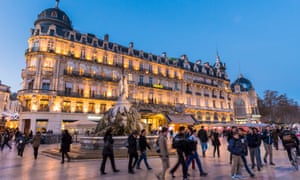
Place de la Comedie in the centre of Montpellier.
Photograph: Iksung Nah/Loop Images/Getty Images
This compact, sun-kissed city
of 275,000 people, located six miles inland from France’s Mediterranean
coast, should be passing Strasbourg as the country’s seventh-biggest.
Any … time … now.
Often overlooked for the bigger southern metropolises of Toulouse and
Nice, and even Provençal tourist-draws such as Avignon and Arles,
Montpellier has been the fastest growing French city over the last
half-century, more than doubling in size from only 119,000 in 1962.
Growing pains
Spend
five minutes on 18th-century plaza Place de la Comédie, and you’ll feel
the livening effects of the city’s massive student intake, who comprise
up to one-third of residents. But for some people, the growth has been
too abrupt.
“My feeling is that the city has lost a bit of its soul,” says Marie
Laure Anselme-Martin, 70, from a local family going back four
generations. “There are very few Montpelliérains with real roots – only
about 15% of the population now. You could put us all in the zoo.”
The city’s journey from poky provincial capital started in the 1960s, when it was first swollen by the influx of pieds-noir (Christian and Jewish people whose families had migrated from all parts of the Mediterranean to French Algeria) and Spanish exiles from Franco. Enter outspoken socialist mayor Georges Frêche. This frank mayor once declared he would name the municipality’s cleaning-supplies room after François Mitterand:
“Un pétit president, une petite salle.” (“A small president, a small
room.”) His development programme – including the love-it-or-hate-it
neoclassical Antigone quarter, and later the Jean Nouvel-designed
town hall, a kind of black Rubik’s cube made Montpellier France’s
“urbanist laboratory”. “Montpellier took off with him,” says
Anselme-Martin, even though she stood in opposition to Frêche as a
municipal councillor. “When he arrived, the city raised the bar very
high.”
City in numbers …
300 Annual days of sunshine. 2,680 Species in the Jardin des Plantes, France’s oldest botanical gardens. 82 Points with which Montpellier HSC did “a
Leicester” and unexpectedly won the French football championship in
2011-12 for the sole time in their history. (They’re currently
mid-table.) 37 Percentage of youth unemployment in the city –
testament to ongoing economic stagnation in the south, and Montpellier’s
reputation as a cushy beach-bum option.
… and pictures
There’s a Lynchian frisson to Montpellier by night, according to photographer Yohann Gozard. His local nightscapes are currently showing at La Panacée gallery’s Retour sur Mulholland Drive exhibition.
History in 100 words
Unlike
its illustrious neighbours, Montpellier has no Greek or Roman heritage.
First mentioned in AD 985, it grew to prominence in the Middle Ages,
thanks partly to a school of medicine that quickly became a European
leader and is now the world’s oldest active medical faculty. Former
pharmacist Anselme-Martin says Montpellier’s research culture is one of
its highlights: “I bathed in it. I’ve got lots of friends in the
research world, they’re people I appreciate because they’re humble.”
Open-mindedness was key: in 1180, William VIII decreed that anyone,
including Jews and Muslims, could practice in Montpellier – though not
apothecaries, as Nostradamus, expelled for being one, would learn.
Today, the medico-botanical influence is still evident in the scores of
biotech and agribusiness companies.
The Med’s little-known skanking outpost, Montpellier has a vibrant
roots-reggae scene dating back to the late 1990s. Since 2010, record
label Salomon Heritage has taken the reins broadcasting the Jamaican
sound system tradition to the Languedoc and further afield.
Surprisingly for a small city, Montpellier has ranked high in recent
studies of France’s most congested places, rivalling Marseille and
Paris. It’s less surprising when you look at the thick tangle of
arterial roads and exurban sprawl surrounding it. Cutting a 12km scar
through the red loam to the south of the city since 2014, is the massive A9 building site –
currently the country’s largest motorway construction project, designed
to siphon off all non-commuter traffic and reroute it southwards.
What’s next for the city?
With
real-estate development sprouting up on every side, Montpellier’s
mayor, Philippe Saurel, is still fixated on showy flagship projects. The Belaroia
(“jewel” in Occitan) is a new luxury hotel and apartments complex
expected to be completed opposite central Gare St Roch at the end of
2018, where a fifth tram line – a new axis linking villages to the north
and southwest – may intersect by 2025.
Then there is the flashy 55m L’Arbre Blanc
tower, stylistically situated “between Japan and the Mediterranean”.
Anselme-Martin has her doubts: “These showcase buildings – are they
going to work? Can people afford this housing? Because
Languedoc-Roussillon is nearly France’s poorest region. Not much work, a
lot of unemployment.”
There are certainly signs of development mania. The overarching
Occitan region recently withdraw its share of funding for a new €135m
out-of-town train station already under construction, after learning
that only four TGVs a day will stop there on its initial opening in
2018.
With all this activity, one thing is sure: Nantes, France’s sixth
biggest city with a population of about 285,000, is now in Montpellier’s
sights.
Close zoom
The lively but slightly-too-Saurel-friendly Gazette de Montpellier is the local Time Out. MontpellierCityCrunch is the buzziest events guide. The underground-orientated Jacker magazine is Montpellier’s answer to the Beastie Boys’ Grand Royale.
On March 8th, International Women's Day, following a 9 km end-of-winter walk
through leafless vineyards near the medieval village of Les Matelles, four
members of AWG-LR were joined on a bridge by 4 members of BCA and FOAL.
There were pink shirts, pink pants, pink back-packs, pink socks,
and even pink undies, all part of the group's participation in the Join Me on the
Bridge campaign.
The campaign started in 2010 when women from the
neighboring warring countries of Rwanda and the Democratic Republic of Congo
came together in a plea for peace on a crossing between the two countries. Since then, each year on March 8th, on real or virtual bridges, people around the world stand in solidarity with all women touched by war.